Cryptocurrencies
Broccoli (BROCCOLI) Meme Coin Pump Explained: Why It Spiked to $0.14 and Crashed Back — Is It a Good Investment Now?

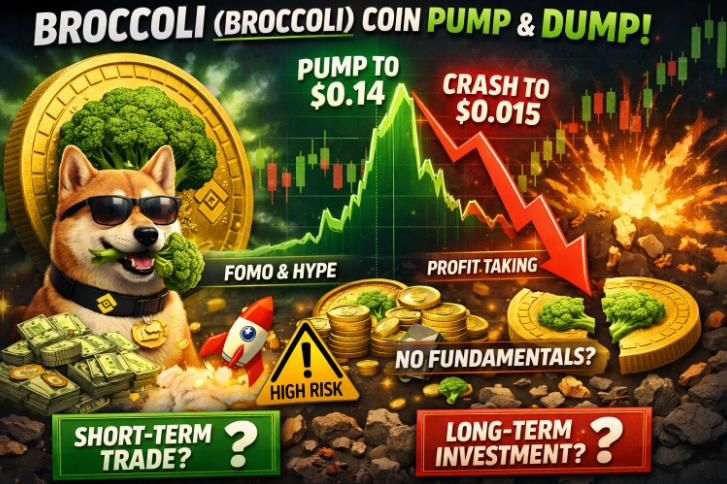
Cryptocurrency markets are known for wild price swings — but few tokens have illustrated that better than Broccoli (BROCCOLI), a meme coin born out of a viral social media moment involving Binance’s former CEO Changpeng Zhao (CZ) and his dog Broccoli. In recent trading sessions, this token briefly spiked to near $0.14, only to crash back to the $0.015–$0.02 range. So what caused this erratic behavior — and is Broccoli worth buying now? Let’s break it down.
What Is Broccoli (BROCCOLI) Coin?
Broccoli is a meme coin — a cryptocurrency with no fundamental utility like DeFi protocols, blockchain infrastructure, or smart contract utility. It originated from CZ’s post revealing his dog’s name “Broccoli,” which triggered massive community interest and speculative trading activity. Traders launched thousands of Broccoli-themed tokens trying to capture the hype. Binance
Unlike major projects, Broccoli doesn’t have a traditional development roadmap or product — it thrives on community sentiment and speculative frenzy rather than fundamentals.
Why Broccoli Pumped to ~$0.14
The surge to roughly $0.14 (or even higher intraday levels on some exchanges) is almost entirely attributable to speculative trading dynamics:
1. Social Media Hype & FOMO
The meme coin’s connection to CZ — an influential figure in crypto — created an emotional, viral meme narrative. Investors flooded in hoping for quick gains once the token started trending. Binance
2. Whale Activity & Momentum Trading
Large holders (often called “whales”) can rapidly drive prices higher by accumulating tokens, triggering automated trading bots and retail traders to buy in — pushing prices up further before they exit. These pumps often precede equally quick sell-offs.
3. Low Liquidity & Volatility
Broccoli trades with relatively thin liquidity compared to top cryptocurrencies. Low liquidity amplifies price movements — a relatively small amount of capital can push prices dramatically higher or lower. CoinGecko
As price spiked, short-term traders likely took profits, forcing the price back down.
Why the Crash Back to $0.015–$0.02
After reaching elevated intraday levels:
1. Profit Taking
Many early traders likely sold at high prices to lock in profits, causing selling pressure.
2. Pump-and-Dump Behavior
Meme coins often exhibit classic pump-and-dump cycles: price goes up quickly due to hype, then dumps just as fast when buying pressure fades.
3. Lack of Fundamentals
Without utility, revenue, or adoption metrics supporting its price, Broccoli lacks intrinsic demand — meaning price depends entirely on trader sentiment.
Combined, these factors make Broccoli extremely volatile — and the recent drop back to around $0.015–$0.02 reflects a retreat to typical trading levels after an emotional surge.
Is Today’s Price Action Normal for Broccoli?
Yes — meme coins regularly experience short-lived spikes and retracements that have little to do with technological progress and everything to do with hype, social media influence, and speculative flows. Broccoli has likely returned to a range commonly seen for many meme assets once the initial momentum faded.
According to live price charts and exchange data, Broccoli’s price has frequently oscillated dramatically within wide ranges (e.g., between lows around $0.007–$0.012 and occasional highs due to spikes). CoinGecko+1
Fundamental Outlook — What Broccoli Actually Has Going For It
Community Engagement
Broccoli has an engaged community and a meme narrative driving interest — sometimes enough to spark temporary rallies.
Tradable on Major Exchanges
It appears on big platforms and DEXs, which increases accessibility for retail traders.
Risks & Downsides to Consider
No Real Utility or Product
Unlike utility tokens or DeFi coins, Broccoli has no underlying technology or use case that supports long-term value.
High Risk of Pump-and-Dump
It behaves like many meme coins whose prices are driven by speculation, not fundamentals.
Volatility
Broad intraday swings mean huge risk — small holders can get wiped out quickly.
Regulatory and Ethical Concerns
Some analysts have criticized meme coin hype cycles as risky and potentially exploitative for inexperienced traders. BeInCrypto
Is Broccoli a Good Investment Right Now?
Here’s the honest takeaway:
For Short-Term Traders
If you have experience with high volatility and a strict risk strategy (e.g., stop losses), you might trade Broccoli for short bursts — but only with money you are prepared to lose.
For Long-Term Investors
Broccoli is not a traditional investment — it lacks fundamentals, product adoption, or revenue flows. Holding for the long term based on hype alone is extremely risky.
Best Practice
-
Treat Broccoli as speculative trading, not investing.
-
Only use a small allocation of your portfolio, if any.
-
Use risk management (stop losses, position sizing).
Conclusion
Broccoli’s price surge to around $0.14 and the subsequent crash back into the $0.015–$0.02 range reflects classic meme coin dynamics: hype-driven spikes, liquidity amplification, speculative profit-taking, and lack of intrinsic value. While it can generate short-term trading opportunities, Broccoli lacks the fundamentals of serious investment assets — making it suitable only for highly speculative traders aware of the risks.
Final Thought: Meme coins like Broccoli can be fun and profitable on occasion — but they are among the most volatile, unpredictable assets in crypto and should never be treated like long-term investments.


How to Make Rope in Terraria: The Complete Guide

The Best Online Games in the World – Gaming Industry

WWE 2K26: The Ultimate Guide — Tips & Tricks

The Complete Guide to Kerry Eurodyne in Cyberpunk 2077

50+ Funny Pokemon Jokes for Kids That Will Make Them Giggle All Day
How to Make Rope in Terraria: The Complete Guide

Hogwarts Legacy Review: The Ultimate Wizarding World RPG Experience

Phantasmal Flames Card List: Every Card, Every Rarity, Fully Explained

How to Get a PS2 BIOS for PCSX2: The Complete Step-by-Step Guide