
Gaming
Pacific Drive – How to Use Transmuter


Pacific Drive, the first-person driving survival game developed by Ironwood Studios and published by Kepler Interactive, features a mysterious and dangerous world filled with supernatural anomalies. Released on February 22, 2024, for PlayStation 5 and PC (Steam and Epic Games Store), with an Xbox Series X/S version arriving on October 23, 2025, the game challenges players to survive the Olympic Exclusion Zone with only their trusty station wagon. Among the many devices scattered throughout this surreal Pacific Northwest setting, Transmuters stand out as valuable but unpredictable resource converters that can turn your scavenging luck around—if you find the right one.
Read Also: In-Depth Details on Pacific Drive for Xbox and How to Download
What is Pacific Drive?
Before diving into Transmuters, it’s important to understand the game itself. Pacific Drive is set in 1998 in the Olympic Exclusion Zone, a fictionalized abandoned version of the Olympic Peninsula in Washington. This area was once home to the secretive ARDA (Advanced Research Development Agency) organization, whose experiments with LIM (Location Independent Matter) technology created reality-bending anomalies that forced the government to seal off the entire region.
Players explore this procedurally generated world through “runs” or “excursions,” venturing from junction to junction while scavenging resources, avoiding or dealing with anomalies, and racing back to safety before the Zone Storm catches up. Your station wagon is your only companion, requiring constant maintenance, repairs, and upgrades to survive increasingly dangerous zones.
Game Status: The game has sold over one million copies as of February 2025 and received generally positive reviews (79/100 on Metacritic, 83% positive on Steam). It was nominated for Best Debut Indie Game at The Game Awards 2024 and won Best Music at the inaugural Indie Game Awards. A DLC expansion called “Whispers in the Woods” was released on October 23, 2025, and a television adaptation is in development by Atomic Monster.
Understanding Transmuters
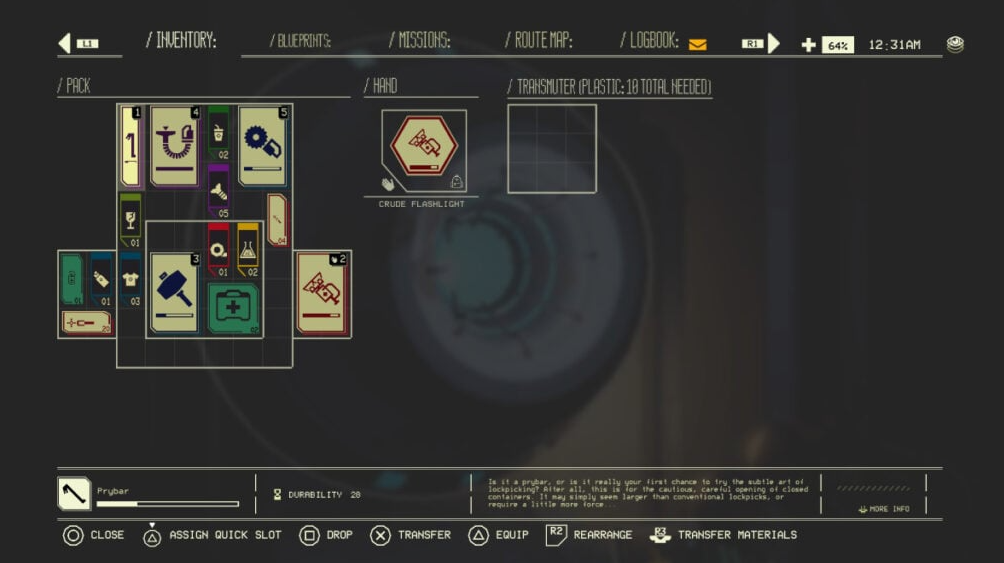
Transmuters, also known as LIM Converters in the game’s lore, are devices created by ARDA that utilize LIM technology to convert one type of resource into another. According to in-game documentation from Dr. A.F. Kingi, these “newer, compact LIM Converters” represent a step toward the original vision of LIM technology, where it could “bridge the gap between the materials given to us and our imaginations.”
In practical terms, Transmuters function as a trading system—you deposit one type of material, and after processing, they output a different material. This can be incredibly useful when you’re short on a critical resource but have an abundance of something less immediately useful.
How Transmuters Work: The Basics
Each Transmuter you encounter operates independently with the following characteristics:
- Input/Output Pair: Each machine converts one specific resource type into another specific resource type
- Variable Conversion Ratio: The number of input items required to produce output items varies (typically 2-10 input items for 1 output item)
- Limited Uses: Each Transmuter has a finite number of conversions it can perform before becoming exhausted
- Randomized: The specific input/output combination is randomly determined when the Transmuter spawns
Important Note: Transmuters are NOT available at your home base (Oppy’s Auto Shop). You can only find and use them during excursions into the Zone.
Where to Find Transmuters
Transmuters spawn randomly throughout the Olympic Exclusion Zone, but certain locations have much higher spawn rates:
Primary Locations
ARDA Towers (Radio Towers) – The most reliable location
- Tall structures with red lights on top
- Transmuters are found inside the tower structure
- Almost always contain a Transmuter when present
- Visible from a distance, making them easy to plan routes around
ARDA Trailers (Portable Cabins) – Secondary location
- Gray portable laboratory structures
- Transmuters can be found behind the door (often where you’d expect a bathroom)
- Less reliable than towers but still common
- Also contain Gas Cylinders, making them worth visiting regardless
Biome Availability
Transmuters can spawn in the following zones:
- Damp Forest (Outer Zone)
- Blistering Woods (Mid Zone)
- The Mires (Mid Zone)
- The Scorch (Deep Zone)
- Red Spires (Deep Zone)
- Smokestacks (Deep Zone)
In late-game zones, you may occasionally find Transmuters just sitting in the open environment, not inside any structure.
Planning Your Route
When selecting your route in the garage before an excursion:
- Check the junction map for high building density
- Prioritize junctions with multiple ARDA structures
- Look for radio tower icons on your map
- Remember that procedural generation means Transmuters aren’t guaranteed even in likely locations
How to Use a Transmuter: Step-by-Step
Step 1: Locate and Approach
When you find a Transmuter, examine its display panel on the front. You’ll see:
- Two icons: Left icon = input resource, Right icon = output resource
- Blue pie chart(s): Shows remaining uses (each segment = one successful conversion)
- The icons use the same symbols as your inventory, but if you’re unsure what they mean, you can interact with the machine to see the actual item names
Step 2: Check Your Inventory
Before attempting to use the Transmuter:
- Open your inventory or check what you’re carrying
- Verify you have the required input material
- Ensure you have enough inventory space for the output
Step 3: Deposit Materials
How to Interact:
- PC: Press E (or your designated interact key)
- PS5: Press Square (or your designated interact button)
- Xbox: Press X (or your designated interact button)
This opens the Transmuter’s inventory interface, showing:
- What it requires (input)
- What it produces (output)
- Your current inventory
The Conversion Process:
- Place the input materials into the Transmuter’s inventory slots
- Close the interface
- The Transmuter will automatically process the conversion
- If you deposited enough material, it outputs the converted resources in front of the machine
- If you didn’t deposit enough, it spits the materials back out at you
Step 4: Determine the Required Quantity (Trial and Error)
Here’s the frustrating part: The game doesn’t tell you exactly how many input items you need. The blue pie chart shows how many conversions are AVAILABLE, not how many items you need.
Common conversion ratios include:
- 2:1 (rare, generous)
- 3:1 (common)
- 4:1 or 5:1 (typical)
- 7:1 or higher (expensive conversions)
- 10:1 (rare, very expensive)
Best Practice:
- Start by depositing 3-5 items
- If they get spit back out, add more (try 7-10)
- Once you get a successful conversion, you know the ratio
- The remaining pie segments show how many more conversions you can make
Step 5: Collect Your Output
After a successful conversion:
- The output material drops on the ground in front of the Transmuter
- Pick it up immediately and store it in your car’s trunk
- One pie segment disappears from the display
- Repeat the process if you have more input materials and the Transmuter has remaining uses
Step 6: Exhaust or Abandon
- Once all pie segments are gone, the Transmuter is exhausted and can’t be used again
- You can leave a Transmuter at any time if the conversion isn’t useful to you
- Transmuters reset when you leave the junction—you can’t return to the same one later
Common Transmuter Conversions
Based on community data, here are some confirmed conversions you might encounter:
Common Conversions:
- Fabric → Copper Wire
- Gears → Electronics
- Glass Shards → Electronics
- Plastic → Chemicals
- Bulbs → Lead Platelets
- Bulbs → Chemicals
- Scrap Metal → Magnets (special location with magnet icon on resource radar)
Valuable Late-Game Conversions:
- Bulbs → Tree Candy (accessing Deep Zone resources from Mid Zone materials)
- Various materials → Thermosap Crystals
- Common resources → Rare chemicals
Note: This is not a complete list, as the game features many possible conversion combinations that appear randomly.
Strategic Use of Transmuters
When to Use Transmuters
Good Situations:
- You’re short on a critical repair material
- The conversion offers rare/late-game resources you can’t normally access yet
- You have excess common materials taking up trunk space
- The conversion ratio is favorable (3:1 or better)
Skip or Ignore:
- The conversion requires materials you need for other purposes
- The output is something you already have plenty of
- The conversion ratio is terrible (8:1 or worse on common materials)
- You don’t have enough input materials to make it worthwhile
Recommended Tools for Transmuter Runs
If you plan to capitalize on Transmuters, pack these tools:
- Scrapper: Breaks down objects for Scrap Metal and components
- Hand Vac: Collects intact Bulbs (can’t get them any other way)
- Liberator: Extracts materials from containers
- Impact Hammer: Breaks open crates and containers
- Prybar: Opens locked doors and containers
Pro Tip: A common mistake is forgetting the Hand Vac and then finding a Bulb → rare material Transmuter. Always pack all your tools!
Inventory Management
- Scout the Transmuter first before gathering materials
- If the conversion is useful, scavenge the junction specifically for that input resource
- Don’t fill your trunk with “just in case” materials before finding a Transmuter—it wastes space
- Prioritize based on what you actually need back at your garage
Advanced Tips and Tricks
Maximizing Efficiency
- Check towers first: When entering a new junction, head to radio towers immediately to see what Transmuters are available
- Adapt your scavenging: Once you know what a Transmuter needs, focus your resource gathering accordingly
- Know your conversion rates: With experience, you’ll learn to estimate ratios and bring the right amount
- Trunk organization: Keep input materials accessible when heading back to a Transmuter
Understanding the Pie Chart
Many players initially think the pie chart segments indicate how many items you need (e.g., 5 segments = 5 items required). This is incorrect.
- Each segment = one available conversion
- 5 segments = you can use this Transmuter 5 times successfully
- After each successful conversion, one segment disappears
- The actual input requirement per conversion is hidden
Risk vs. Reward
Transmuters add an interesting risk/reward element:
- Spending time gathering resources for conversions delays your escape from the Zone Storm
- The randomness means you can’t reliably plan builds around Transmuter access
- However, getting a lucky high-value conversion can dramatically help progression
Transmuters in the “Whispers in the Woods” DLC
The DLC expansion, released October 23, 2025, introduces new zones and mechanics but maintains the same Transmuter system. Players report finding Transmuters in the new Whispering Woods area with conversion options involving DLC-specific resources.
The expansion is approximately one-third the size of the base game and includes new anomalies, enemies, and the Whispering Tide mechanic, but Transmuters continue to function identically to the base game.
Frequently Asked Questions
Is the Transmuter safe to use, or are there any risks involved?
Transmuters are completely safe to use. There are no negative consequences, failed reactions, or dangers. The only “risk” is wasting time gathering materials for a conversion you don’t actually need.
Can the Transmuter convert any material into another, or are there limitations?
Each Transmuter can only convert one specific input material into one specific output material. You can’t choose what to convert—the conversion pair is pre-determined and shown on the display panel.
What happens if I try to put the wrong materials in?
The Transmuter will simply spit them back out in front of the machine. You can then pick them up and either try again with the correct materials or move on.
Can I find the same conversion twice?
Due to procedural generation, you might encounter the same conversion pairing across different runs, but it’s random. You can’t guarantee finding a specific conversion when you need it.
Do Transmuters reset between runs?
Yes, completely. Each excursion generates new junctions with new Transmuters (or none at all). You cannot return to a Transmuter from a previous run.
Are Transmuters necessary to beat the game?
No, Transmuters are entirely optional. You can complete Pacific Drive without ever using one. They’re a convenience and opportunity system, not a core mechanic.
What should I do if I find a conversion I need but don’t have the materials?
Scavenge the current junction thoroughly. Transmuters are only available during that specific run in that specific location, so it’s worth taking time to gather what you need if the conversion is valuable.
Game Performance and Updates
Pacific Drive has received several updates since launch:
- Performance improvements and bug fixes throughout 2024
- The “Whispers in the Woods” DLC (October 2025) added new content
- Extensive difficulty customization options allow players to adjust quirks, damage, and resource scarcity
- The game supports keyboard and mouse on console for enhanced control
Platform Availability (January 2025):
- PlayStation 5
- PC (Steam and Epic Games Store)
- Xbox Series X/S (as of October 23, 2025)
Conclusion
Transmuters in Pacific Drive represent the game’s approach to risk, reward, and adaptation. Unlike many survival games where resource conversion is predictable and systematic, Pacific Drive’s Transmuters embrace randomness and opportunistic play. You can’t plan your entire run around finding one, but when you do encounter a favorable conversion, it can significantly ease your progression through the increasingly hostile zones.
The key to effective Transmuter use is flexibility—be ready to pivot your scavenging strategy when you find a useful conversion, but don’t waste precious time and resources chasing conversions that don’t meaningfully help your current situation. Pack your tools, check those radio towers, and always carry a Hand Vac—you never know when you’ll find that perfect Bulb-to-rare-resource conversion that makes your entire run worthwhile.
As you venture deeper into the Olympic Exclusion Zone, remember that Transmuters are just one of many strange remnants of ARDA’s experiments with LIM technology. They’re a testament to the organization’s vision of bridging the gap between available materials and human imagination—even if that vision came at the cost of reality itself.


Vampire Crawlers Coin Farming Guide

Forza Horizon 6 Performance: Why 60 FPS Is Still the Console Standard

Yoshi and the Mysterious Book (2026) – Full Completion Guide, Rewards & Secret Ending

How to Get Free Pets in Adopt Me: A Guide for Players

Roblox Username Generator – Create a Cool & Unique Username in Seconds
How to Get Free Pets in Adopt Me: A Guide for Players
Yoshi and the Mysterious Book (2026) – Full Completion Guide, Rewards & Secret Ending
Forza Horizon 6 Performance: Why 60 FPS Is Still the Console Standard